
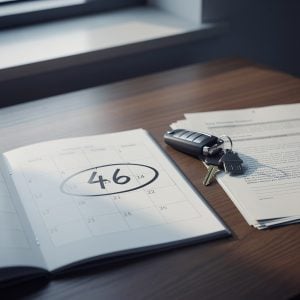
It is 6 a.m. on a Saturday in Joliet. You posted bond a few hours ago after a DUI arrest, your car is impounded somewhere off Larkin Avenue, and you are sitting at your kitchen table holding a stack of paperwork the officer handed you. One of those papers is a Notice of Statutory Summary Suspension. Buried in the fine print is a sentence that should change your weekend plans: in 46 days, the State of Illinois will automatically take your driver’s license — whether you are eventually convicted of DUI or not.
That 46-day clock starts the day you were arrested. The criminal DUI charge gets all the attention because it is what the police talked about, but the summary suspension is a parallel, separate proceeding that moves on its own track and operates under its own deadlines. Miss those deadlines and your license is gone for at least six months, regardless of what happens with the criminal case. Having spent years prosecuting DUI cases in the Will County courthouse before opening this firm, I have watched both sides of this clock. The State has the procedure down to a routine. The driver almost never does.
Day 1 through Day 7: What Just Happened to You Legally
Two separate cases were opened the moment you were processed. The first is the criminal charge under 625 ILCS 5/11-501. That case will be assigned a court date, typically four to six weeks out, at the Will County Courthouse on West Jefferson Street. The second is the statutory summary suspension under 625 ILCS 5/2-118.1, an administrative action by the Illinois Secretary of State. The second case moves faster and hits harder in the short term.
If you took the breath test and registered .08 or above, the suspension will run six months for a first offender or twelve months for someone with a prior DUI or summary suspension within the last five years. If you refused the test, the suspension is twelve months for a first offender and three years for a non-first offender. Refusing does not get you out of the suspension — it makes it longer.
The most important thing to do in this first week is gather every document the officer gave you and bring them to a defense attorney. The Notice of Summary Suspension, the Law Enforcement Sworn Report, the bond paperwork, any breath test result printout, and the citation itself all contain information that determines what defenses are available.
Day 7 through Day 14: The Petition to Rescind Window
Illinois law gives you 90 days from the date of the suspension notice to file a Petition to Rescind Statutory Summary Suspension in the Will County Circuit Court. That deadline sounds generous until you realize that filing the petition does not stop the suspension from starting on day 46. The only thing that stops the suspension is a judge actually granting the petition before that 46th day arrives.
The court is required to hold a hearing within 30 days of when the petition is filed, but only if it is filed properly and served on the State’s Attorney correctly. To realistically beat the 46-day clock, the petition needs to be filed within the first two weeks after arrest. That gives the court time to set the hearing and gives the petition a chance to be heard while it still matters.
The five statutory grounds for rescission are narrow: the officer lacked reasonable grounds to believe you were under the influence, you were not properly warned of the consequences of refusal, the chemical test was not administered or interpreted properly, the test did not actually show a result above the legal limit, or the arrest was not for a qualifying offense. The burden of proof is on the driver. Familiarity with how Will County Assistant State’s Attorneys handle these hearings — which grounds draw stronger pushback and which can be argued with less resistance — matters here.
Day 14 through Day 30: Discovery and Evidence Preservation
Two weeks in, the criminal case starts catching up. This is when subpoenas should go out for any squad car dashboard camera, body camera, or police station booking video that exists. Will County police agencies do not retain this footage indefinitely — some local departments overwrite it within 60 to 90 days unless a preservation request is filed. Waiting until the first court date to ask is too late in some cases.
Field sobriety test administration is one of the richest sources of defense evidence. The standardized tests have specific protocols set by the National Highway Traffic Safety Administration, and officers are required to give specific instructions in a specific order. Departures from protocol give a defense attorney material to challenge the officer’s conclusions. A medical condition, footwear, the slope of the road, the lighting at the scene — all of these can corrupt a test that the officer scored as a failure.
If a breath test was administered at the station, the maintenance and calibration records of the breathalyzer become relevant. A device that was overdue for calibration or had a recent failed accuracy check produces results that may be suppressible.
Day 30 through Day 46: The Hearing or the Suspension
If the petition was filed on time, the rescission hearing will happen sometime in this window. The arresting officer will be subpoenaed to testify. The hearing is conducted before the same judge who will eventually hear the criminal case, but it is a civil proceeding governed by the preponderance of the evidence standard rather than beyond a reasonable doubt. The driver has the burden, but the burden is lower.
If the petition is granted, the suspension is rescinded and the order has to be physically transmitted to the Secretary of State’s office in Springfield to stop the suspension from being entered on your driving record. If the petition is denied, or if no hearing happened in time, the suspension takes effect on the 46th day. For first offenders whose suspension takes effect, the Monitoring Device Driving Permit (MDDP) becomes the next priority — it allows unlimited driving during the suspension, but only in a vehicle equipped with a Breath Alcohol Ignition Interlock Device (BAIID).
Day 46 and Beyond: The Criminal Case Continues
Even after the suspension question is resolved, the criminal DUI case continues on its own track. A first offense DUI is a Class A misdemeanor, punishable by up to one year in jail and fines up to $2,500. Court supervision is available for a first offense and is the most favorable disposition because, if successfully completed, it does not result in a conviction or a license revocation. But court supervision is a one-time-in-a-lifetime offer for DUI in Illinois — second offenses are not eligible.
Aggravating factors elevate even a first DUI to felony territory. A child under 16 in the vehicle, an accident causing bodily injury, driving on a suspended or revoked license at the time of arrest, or a BAC of .16 or higher all change the analysis significantly. For commercial driver’s license holders, the consequences are even more severe: a CDL holder loses CDL privileges for one year on a first DUI and for life on a second — even if driving a personal vehicle at the time of arrest.
The Cost of Waiting
The 46-day clock is not a recommendation. It is automatic, runs in the background regardless of what you are doing about it, and cannot be paused once it starts. Drivers who call a defense attorney within the first week have meaningfully better outcomes on the suspension question than those who wait until their first court date. By the time of the first criminal court appearance, four to six weeks after arrest, the petition window has often closed in any practical sense.
If you have been arrested for DUI in Joliet or anywhere in Will County, the Law Offices of Jack L. Zaremba, P.C. handles both the criminal case and the summary suspension as a single coordinated defense. Call 815-740-4025 for a free consultation, or visit our contact page. We are available 24 hours a day because the clock does not stop on weekends or holidays. To learn more about the specific charges and penalties involved, see our pages on first offense DUI and available DUI defenses in Illinois.