
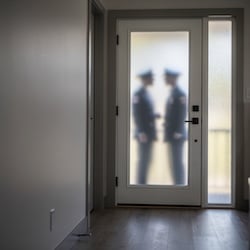
 Most people believe that when the police knock, you have to open the door. In Illinois, you usually don’t. Your home is the single most protected space the Fourth Amendment recognizes, and a knock — even a loud, late-night, fist-on-the-door knock — does not by itself give an officer the right to come in, or the right to make you answer. Knowing that one fact, and knowing how to act on it calmly, can be the difference between a closed door and a criminal case built on what happened inside your home.
This plays out constantly in Will County. An officer shows up at a house in Joliet, Plainfield, or New Lenox, knocks, and says they “just want to talk” or “need to clear something up.” The resident, wanting to seem cooperative and having no idea what the law actually requires, opens the door and starts answering. Minutes later the officer is inside, has seen something in plain view, and has the beginnings of a case — none of which was required. Here is what the law actually says, and what you should do when it happens to you.
Why a “Knock and Talk” Is One of the Most Effective Tools Police Have
The encounter you’re picturing has a name: a “knock and talk.” Officers approach a home without a warrant, knock on the front door, and try to start a conversation. The goal is almost never small talk — it’s to gather information, get consent to come inside or search, or get you to say something usable later. Police rely on this tactic precisely because they don’t yet have enough evidence for a warrant, and a friendly doorway conversation is a way around that requirement.
The U.S. Supreme Court has said officers may walk up and knock the same way a neighbor or delivery driver could — but it has been just as clear that the occupant has no obligation to open the door or to speak. The implied license to be on your porch is narrow. Officers can knock, wait a reasonable moment, and must leave if no one answers. They cannot treat your silence as suspicion, they cannot linger indefinitely, and they cannot wander the property or bring a drug-sniffing dog up to your door — the Court has treated that last move as a search that requires a warrant. The protection extends to the “curtilage,” the area immediately around the home, which is why your porch and front steps get the same shield as your living room.
Police Need a Warrant, Your Consent, or a Real Emergency to Come Inside
Warrantless entry into a home is presumptively unreasonable. In practice that means an officer generally needs one of three things to legally cross your threshold: a valid warrant, your consent, or a genuine emergency.
Consent is where most people give up their rights without realizing it. The moment you say “sure, come in,” or step back and wave an officer through, you’ve waived the warrant requirement — and anything in plain view becomes fair game as evidence. You don’t have to consent, and declining is not an admission of anything. A genuine emergency — what courts call “exigent circumstances” — can justify entry without a warrant: someone screaming for help, a suspect fleeing inside, or evidence being destroyed in real time. The key word is genuine; an officer’s curiosity is not an emergency. A warrant is the strongest authority police have, and the kind of warrant matters more than most people realize.
Search Warrant or Arrest Warrant? The Difference Decides What Happens Next
There are two kinds of warrants, and they do very different things. A search warrant authorizes officers to enter a specific place and look for specific items, and it has to describe both with particularity — a vague “search the house for anything illegal” warrant is invalid. If officers have a valid search warrant for your home, they can come in whether you cooperate or not, so a standoff accomplishes nothing — but you should still ask to see it.
An arrest warrant is different. An arrest warrant for you allows officers to enter your own home to arrest you if they reasonably believe you’re inside. But an arrest warrant for someone else generally does not let them search your home to find that person — for that, they typically need a separate search warrant. So if officers are at your door looking for a roommate, a relative, or a guest, an arrest warrant for that person does not automatically open your home to a search. If police claim to have a warrant, ask them to show it — they can hold it to a window or slide it under the door — and read what it covers: the address, the judge’s signature, and the scope.
What to Do If the Police Are Standing at Your Door
You can handle this calmly and still protect yourself completely. If officers knock and you choose to respond, you do not have to open the door — you can talk through it. Ask the simple question: “Do you have a warrant?” If the answer is no, you can say, politely and clearly, that you do not consent to any entry or search, and that they’re welcome to leave a card so your attorney can contact them. Then you can stop talking. You are not required to explain yourself, confirm who lives there, or account for your evening.
A few specifics matter. Don’t step outside to talk unless you’re being ordered to — stepping out can expose you to arrest and can be treated as giving up ground you didn’t have to give. Don’t crack the door open to “just hand them something” or to prove you have nothing to hide; an open door is an invitation to plain-view observation. In Illinois you are allowed to record police carrying out their public duties, and a recording of the encounter — from inside your home or on a doorbell camera — can be powerful protection if there’s later a dispute about what was said. And if officers genuinely do have a warrant or an emergency, they won’t be asking permission; in that situation you don’t physically interfere, you step aside and let your lawyer fight it later.
Don’t Force the Issue by Resisting — You Fight an Illegal Entry in Court
This is the part that trips people up, and it’s the most important. Even if an entry or search feels obviously illegal, the doorway is not where you win that fight. Physically blocking, shoving, or struggling with an officer can itself be a crime. Under 720 ILCS 5/31-1, knowingly resisting or obstructing a peace officer performing an authorized act is a Class A misdemeanor — up to 364 days in jail and a $2,500 fine — and Illinois law adds a mandatory minimum of 48 consecutive hours in jail or 100 hours of community service, with no court supervision available to keep it off your record. If your resistance is the proximate cause of injury to the officer, the charge jumps to a Class 4 felony, punishable by one to three years in prison.
The right move is the opposite of resistance. You assert your rights with words, you don’t consent, and you don’t fight. Then, if police got inside or searched without legal authority, the place to attack that is your defense against the resulting charges and a motion to suppress — asking a Will County judge to throw out everything the officers found because they obtained it unlawfully. A successful suppression motion can gut the State’s case. The same discipline applies to questioning: you have the right to stay silent and to have a lawyer, and our page on police questioning and Miranda warnings explains how quickly a “casual” doorway conversation becomes the centerpiece of a prosecution.
What a Former Will County Prosecutor Sees in These Cases
As a former Will County prosecutor, Attorney Jack Zaremba has watched these cases from the other side, and the pattern is almost always the same. The strongest evidence didn’t come from a warrant or a careful investigation — it came from a few minutes at a doorway, where someone opened up, let officers in, or started explaining. What feels like cooperation in the moment becomes the backbone of the State’s case by the time it reaches the courthouse in Joliet. Defendants are routinely surprised to learn how much of the case against them they handed over voluntarily, and how often a clean motion to suppress could have changed everything if the entry was unlawful to begin with. Understanding your rights before that knock comes — and then staying calm, polite, and quiet — is the cheapest and most effective protection you have.
If the police have come to your door, searched your home, or charged you after an encounter you’re not sure was legal, talk to a lawyer before you talk to anyone else. The Law Offices of Jack L. Zaremba offers a free consultation — call 815-740-4025 or reach out through our contact page. As a former Will County prosecutor, Attorney Zaremba knows exactly how these cases are built, and how to take them apart.
Frequently Asked Questions
Do you have to answer the door for police in Illinois?
No. In most situations you are not required to open the door or even respond when police knock. Your home receives the highest level of Fourth Amendment protection, and officers generally need a warrant, your consent, or a genuine emergency before they can enter. You can speak through the door, ask whether they have a warrant, and decline to let them in.
Can the police come into my home without a warrant?
Only in limited circumstances: if you consent by inviting them in or agreeing to a search, if there is a true emergency such as someone in danger or evidence being destroyed, or if they are in hot pursuit of a suspect. Absent one of those, a warrantless entry into your home is presumptively unlawful in Illinois.
What is the difference between a search warrant and an arrest warrant at my door?
A search warrant lets officers enter and search a specific place for specific items, and they can come in whether or not you cooperate. An arrest warrant lets them enter your own home to arrest you if they reasonably believe you are there, but an arrest warrant for someone else usually does not authorize a search of your home. Always ask to see the warrant and check the address, signature, and scope.
Should I step outside to talk to the police?
Generally no. You can talk through a closed door. Stepping outside can expose you to questioning and arrest and can be treated as surrendering protections you otherwise had. If you choose to speak at all, keep it brief and do not consent to entry or a search.
Can I get in trouble for not letting the police in?
Declining consent and refusing to open the door is your right and is not a crime. What can be charged is physically resisting or obstructing officers under 720 ILCS 5/31-1, a Class A misdemeanor. Assert your rights with words, not force: do not consent, do not interfere, and let your attorney challenge an unlawful entry in court.
The police searched my home without a warrant. What can I do?
If officers entered or searched without legal authority, an attorney can file a motion to suppress, asking the court to exclude any evidence they obtained. In Will County, a successful suppression motion can significantly weaken or even end the State’s case. Contact a criminal defense lawyer as soon as possible and write down everything you remember about the encounter.
This post is for informational purposes only and does not constitute legal advice. Results vary by case..