
As of January 1, 2026, Illinois gun owners face a significant new legal obligation. The Safe Gun Storage Act, enacted through Senate Bill 8 and signed by Governor Pritzker as Public Act 104-0031, requires firearm owners to secure their weapons in a locked container whenever a minor, an at-risk person, or a prohibited person is likely to gain access. The law applies at home, in a vehicle, and at any other location where a firearm is stored or left. For gun owners in Joliet and throughout Will County, this is not a suggestion or a best practice. It is enforceable law with a tiered penalty structure that escalates to $10,000, and the consequences extend well beyond the fines themselves.
This is the kind of law that catches responsible gun owners off guard. It does not require that someone actually access the weapon. It does not require that a crime be committed with the firearm. The mere fact that a firearm was stored in a way that a protected person could likely reach it is enough to trigger a violation.
What the Safe Gun Storage Act Requires
The core obligation is straightforward but has real teeth. A firearm owner may not store or keep any firearm in any premises where the owner knows or reasonably should know that a minor (anyone under 18), an at-risk person, or a person prohibited from possessing firearms is likely to gain access. The firearm must be secured in a locked container or equipped with a tamper-resistant safety device that renders it inaccessible or unusable to anyone other than the owner or another lawfully authorized user.
The law defines “at-risk person” broadly to include individuals who may be a danger to themselves or others. A prohibited person includes anyone who is barred from possessing firearms under existing Illinois or federal law, such as convicted felons or individuals subject to orders of protection. In Attorney Zaremba’s experience defending weapons and gun charges in Will County, the most common scenario this law targets is the household where a FOID card holder keeps an unsecured firearm accessible to children or to someone with a revoked FOID. That nightstand drawer, the closet shelf, the unlocked glove compartment — under SB 8, all of these are now legally insufficient if a protected person could access the weapon.
There is an important exception. If the firearm is carried by or under the direct control of the owner or another lawfully authorized user, it is considered lawfully stored. In other words, a holstered weapon on your person does not violate the law. But the moment you set it down, store it, or leave it unattended in any location where a protected person could access it, the storage requirement applies.
The Tiered Penalty Structure: $500 to $10,000
The penalties under the Safe Gun Storage Act are civil, not criminal, but they are structured to escalate based on what happens after the violation. The base penalty for a standard violation where no unauthorized access actually occurs is a civil fine of up to $500. If a minor, at-risk person, or prohibited person actually gains access to the unsecured firearm, the maximum fine increases to $1,000. If the unsecured weapon is used to cause injury, death, or is used in the commission of a crime, the penalty jumps to $10,000.
The Will County State’s Attorney or the Illinois Attorney General can bring an action to collect these penalties. A judge also has discretion to order community service or restitution in lieu of the fines if good cause is shown. All money collected from these civil penalties is deposited into the state’s Mental Health Fund.
What many gun owners do not realize is that these civil penalties are only the beginning. The law explicitly states that a violation of the Safe Gun Storage Act constitutes prima facie evidence of negligence per se in any civil proceeding where a minor, at-risk person, or prohibited person obtains the firearm and causes personal injury, death, or uses it in the commission of a crime. That legal term — negligence per se — is significant. It means the gun owner’s violation of the statute is automatically treated as proof of negligence in a lawsuit. The injured party does not have to separately prove that the gun owner was careless. The storage violation alone establishes it. As a former Will County prosecutor who has seen how these civil and criminal consequences compound, Attorney Zaremba knows this creates substantial exposure for gun owners who are not in compliance.
The 48-Hour Reporting Rule for Lost or Stolen Firearms
SB 8 also tightened the timeline for reporting missing weapons. Illinois law previously required gun owners to report a lost or stolen firearm to local law enforcement within 72 hours of discovering it was missing. The Safe Gun Storage Act reduced that window to 48 hours. For gun owners in Will County, this means contacting the Joliet Police Department, the Will County Sheriff’s Office, or whatever local law enforcement agency has jurisdiction within two days of learning a firearm is unaccounted for.
Failing to report promptly does not just risk a separate violation. In a situation where an unreported stolen firearm is later used in a crime, the failure to report becomes part of the timeline that prosecutors and civil attorneys will use to build a case. A gun owner who waited too long to report and also stored the weapon improperly faces compounding liability on both fronts.
How Will County Courts Are Likely to Handle These Cases
While the Safe Gun Storage Act is still relatively new, cases arising from it will be handled through civil proceedings in Will County. What most attorneys do not tell you about weapons-related legal proceedings in Will County is that even civil gun cases draw serious judicial attention. Judges in the Will County courthouse have handled a high volume of unlawful use of weapon cases for years, and they are well-versed in firearms law. The idea that a civil penalty means a lenient outcome would be a mistake. The negligence per se provision alone transforms a storage violation from a fine into potential six-figure civil liability if someone is injured.
Gun owners should also understand how this law interacts with existing Illinois firearms statutes. A person who violates the Safe Gun Storage Act is not necessarily facing criminal charges under that specific law, but if the circumstances also involve a minor gaining access to a weapon and causing harm, prosecutors may pursue separate criminal charges under the Criminal Code of 2012, including endangerment or reckless conduct offenses. These carry criminal penalties, including potential jail or prison time depending on the classification. A Class A misdemeanor conviction means up to 364 days in jail and a $2,500 fine. A felony charge changes the picture entirely, with a Class 4 felony carrying one to three years in prison and fines up to $25,000.
Steps Every Gun Owner in Will County Should Take Now
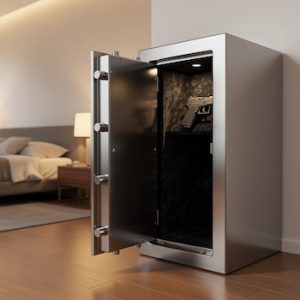
Compliance is not complicated, but it does require deliberate action. Every firearm in a home, vehicle, or other location where a minor, at-risk person, or prohibited person could gain access must be stored in a locked container or equipped with a safety device that prevents unauthorized use. Gun safes, lockboxes, trigger locks, and cable locks all satisfy the requirement if they genuinely render the firearm inaccessible. Simply placing a firearm on a high shelf, hiding it under a mattress, or keeping it in an unlocked drawer does not meet the standard under SB 8.
Gun owners should also audit their household situation. If a teenager lives in or regularly visits the home, the law applies. If a roommate or family member has a revoked FOID card or a felony conviction, the law applies. If anyone in the household has been identified as a danger to themselves or others — including through a firearms restraining order or a mental health determination — the law applies. The obligation is triggered not by certainty but by what the gun owner knows or reasonably should know.
If you have already been contacted by law enforcement or the Will County State’s Attorney’s Office regarding a potential storage violation, or if a firearm was accessed by an unauthorized person in your household, do not provide statements without consulting an attorney first. These cases involve overlapping civil and criminal exposure that requires careful handling from the outset.
For legal guidance on weapons charges, FOID compliance, or the new Safe Gun Storage Act in Joliet and throughout Will County, contact the Law Offices of Jack L. Zaremba, P.C. for a free consultation. With more than 20 years of criminal law experience, including service as a Will County prosecutor, Attorney Zaremba understands how these cases are investigated and pursued. Call 815-740-4025 or visit our contact page to schedule a consultation.