
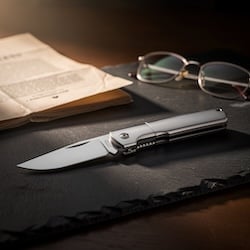
If you own or carry a switchblade in Illinois — or you’re thinking about it — the first question is usually simple: is it legal? The answer is yes, but with an important condition that surprises most people. Whether you’re carrying a pocket knife in Joliet or wondering what you can legally keep in your car, Illinois knife laws are more complicated than a simple “legal or illegal.” This guide breaks down what’s allowed, what’s banned, and where even a legal knife can get you charged. For the full picture of weapons charges, see our Illinois weapons, gun, and FOID charges page.
Are Switchblades Legal in Illinois?
Switchblades — and other automatic knives, including out-the-front (OTF) knives — are legal to own and carry in Illinois only if you have a valid Firearm Owner’s Identification (FOID) card. Without one, possessing a switchblade is a Class A misdemeanor. You generally must be 21 or older to hold a FOID card, or 18 with the consent of a parent or guardian who is themselves FOID-eligible.
This is a relatively recent change. For years, 720 ILCS 5/24-1 — the Unlawful Use of Weapons (UUW) statute — banned switchblades outright. Public Act 100-0082, signed in August 2017, created the FOID-card exception, and a later amendment effective January 1, 2022 went further, legalizing the sale and manufacture of switchblades for FOID cardholders as well. So in Illinois today, the switchblade question really comes down to one thing: do you have a valid FOID card?
What Knives Are Illegal in Illinois?
Two types of knives are banned for everyone in Illinois, with no FOID exception:
- Ballistic knives — knives that propel a blade as a projectile by spring or compressed gas. Possession is a Class 4 felony, and carrying one while masked or hooded escalates the offense further.
- Throwing stars — prohibited statewide under the same UUW statute.
A second category of knives is legal to own and carry — but only up to a point. Daggers, dirks, stilettos, and other “dangerous knives” are not banned outright. However, under 720 ILCS 5/24-1(a)(2), carrying or possessing one with the intent to use it unlawfully against another person is a Class A misdemeanor. The knife itself isn’t the problem; the intent is. This is why so many Illinois knife cases turn on what the State can prove about why you were carrying it.
Is There a Blade-Length Limit in Illinois?
One of the most common misconceptions about Illinois knife laws is that there’s a statewide blade-length limit. There isn’t. Illinois does not impose a general blade-length cap for ordinary carry, and the concealed-carry prohibition in the UUW statute applies to firearms — pistols, revolvers, stun guns, and tasers — not to knives as a category.
That said, two big exceptions matter. Blades of three inches or longer are restricted on public-funded property (more on that below), and local ordinances frequently impose their own limits. Butterfly knives (balisongs), by the way, are not classified as switchblades under Illinois law and are generally legal to own and carry.
Where You Can’t Carry a Knife in Illinois
Even a perfectly legal knife can lead to charges depending on where you carry it — and this is where otherwise law-abiding people get into trouble. Under 720 ILCS 5/21-6, possessing a knife with a blade of at least three inches on public-funded land or in a public-funded building, without written permission, is a Class A misdemeanor.
Certain locations carry far harsher consequences. Carrying a prohibited weapon in or near a school, public park, courthouse, or public housing development — or on any public way within 1,000 feet of one — can elevate a misdemeanor to a Class 4 felony. That 1,000-foot buffer is larger than most people realize, and in a developed area like Joliet, those zones overlap more of the map than you might expect.
Joliet and Local Knife Ordinances
State law is only the floor. Illinois municipalities are free to enact stricter knife regulations, and many have. Chicago, for example, caps knife blades at 2.5 inches in public and bans knuckle-knives entirely. Joliet maintains its own weapons ordinances addressing concealable and dangerous weapons.
The practical takeaway for anyone in Will County: a knife that is perfectly legal under state law can still violate a local code. If you carry a knife regularly — for work, for hunting, or otherwise — it’s worth understanding both the Illinois statute and the ordinances of the specific cities where you carry. A Joliet weapons charge can arise from a local violation even when state law would have allowed the knife.
Penalties for an Illinois Knife Charge
Most knife violations in Illinois are Class A misdemeanors, punishable by up to 364 days in county jail and fines up to $2,500. But the consequences escalate quickly. Aggravated unlawful use of a weapon under 720 ILCS 5/24-1.6 is a Class 4 felony on a first offense, carrying one to three years in prison — and it applies when a weapon is carried in a prohibited location, by a minor, or under other aggravating circumstances.
The collateral consequences matter too. A weapons conviction shows up on background checks and can complicate employment. And for anyone under 21, a non-traffic misdemeanor conviction disqualifies them from obtaining a FOID card — which, in turn, eliminates the very exception that makes switchblade possession legal.
Charged With a Weapons Offense in Joliet?
If you’ve been charged with a knife or weapons offense in Joliet or anywhere in Will County, the details of the charge matter enormously — and many of these cases are more defensible than they first appear. Attorney Jack Zaremba is a former Will County prosecutor who understands how the State builds and proves these cases.
Common defense strategies in Illinois knife and UUW cases include challenging whether the State can actually prove “intent to use unlawfully” (the prosecution carries that burden, and lawful purpose is a defense), challenging the legality of the search that produced the knife, raising FOID-status defenses in switchblade cases, and contesting the location element in felony-enhancement charges. To learn more, see our pages on unlawful use of a weapon and our broader Joliet criminal defense practice.
Contact a Joliet Weapons Defense Attorney
If you’re facing a knife or weapons charge in Will County, don’t talk to police or enter a plea before speaking with a defense attorney. Call the Law Offices of Jack L. Zaremba at 815-740-4025 or visit our contact page to discuss your case.
Frequently Asked Questions About Illinois Knife Laws
Do you need a FOID card to carry a switchblade in Illinois?
Yes. Under current Illinois law, switchblades and other automatic knives are legal to own and carry only for individuals with a valid Firearm Owner’s Identification (FOID) card. Without a FOID card, possessing a switchblade is a Class A misdemeanor. The FOID exception was created by Public Act 100-0082 in 2017 and expanded effective January 1, 2022.
Are automatic and OTF knives legal in Illinois?
Automatic knives, including out-the-front (OTF) knives, are treated the same as switchblades under Illinois law. They are legal to own and carry with a valid FOID card and illegal to possess without one. Local ordinances may impose additional restrictions, so it is worth confirming the rules in your specific city.
What knives are illegal in Illinois?
Ballistic knives and throwing stars are banned statewide for everyone, with no FOID exception — possession of a ballistic knife is a Class 4 felony. Daggers, dirks, stilettos, and other “dangerous knives” are legal to own but become illegal when carried with the intent to use them unlawfully against another person.
Is there a legal blade length in Illinois?
Illinois does not impose a statewide blade-length limit for ordinary carry. However, knives with blades of three inches or longer are restricted on public-funded property under 720 ILCS 5/21-6, and local ordinances — such as Chicago’s 2.5-inch limit — can be stricter than state law.
Are butterfly knives (balisongs) legal in Illinois?
Yes. Butterfly knives, also called balisongs, are not classified as switchblades under Illinois law and are generally legal to own and carry. As with any knife, carrying one with unlawful intent, or onto restricted public-funded property if the blade is three inches or longer, can still result in charges.